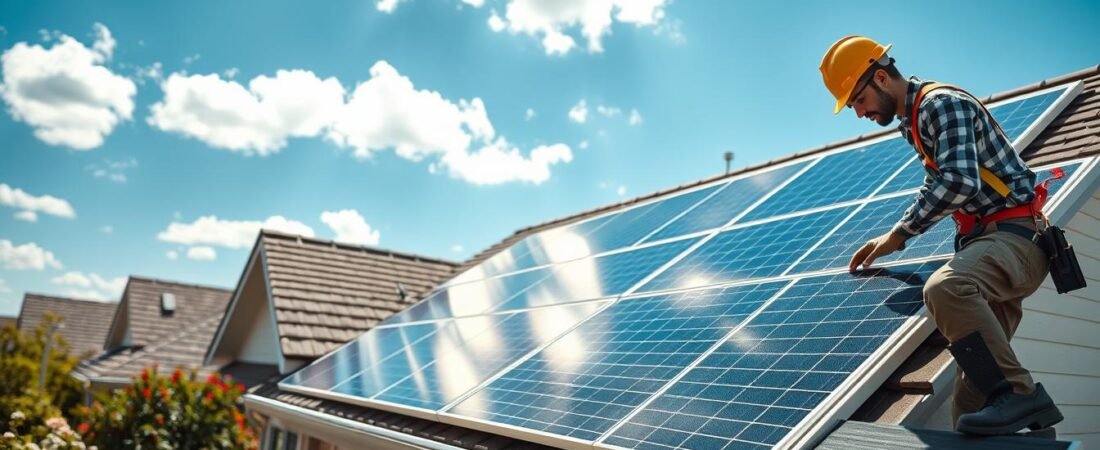
Thinking about switching to rooftop power? Many homeowners see this upgrade as a long-term investment that cuts bills and adds value. In fact, families often save between $37,000 and $154,000 over 25 years when they move to solar energy.
Today, prices are near historic lows, and a typical setup meets a standard household’s needs with roughly a 12 kW system. That size has an average sticker of about $30,505 before local incentives and tax credits.
To understand true pricing, look at equipment, labor, and the rebates or credits in your state. Picking the right system size and location on your roof helps maximize savings and shield you from rising utility bills.
Our guide walks you through the numbers and shows why many find panels a smart, lasting choice for clean electricity and financial security.
Understanding the Solar Panel Installation Cost for Home
Estimating what you’ll pay starts with the size of the system you need and how much power your household uses.
Nationally, a 6 kW system starts at about $17,000 before incentives. In Texas, that same 6 kW setup often runs nearer to $16,000 pre-tax breaks.
These figures cover basic equipment and labor but not every variable. Panel quality, inverter type, and a complex roof layout can raise the price.
Systems commonly deliver useful electricity for 25 years or more. That longevity turns upfront spending into long-term savings on monthly bills.
- Match system size to your daily use to avoid overpaying.
- Compare multiple quotes to find the best value and available incentives.
- Decide whether to buy, finance, or lease based on your budget and goals.
Understanding upfront numbers helps homeowners plan and choose confidently.
Breaking Down Equipment and Labor Expenses
Nearly half of what you pay goes to gear and another half covers labor and overhead.
Hardware and components
Equipment — including supply-chain fees and sales tax — makes up about 46% of the total system price. The modules themselves are less than a third of that equipment line.
Racking, wiring, and inverters also add up. Choosing higher-quality equipment often yields better savings over the long run, even if the initial price per watt is higher.
Inverter technology
Inverters convert DC into AC and commonly cost a few thousand dollars each. Good inverters improve output and lower maintenance needs over the coming years.
Permitting and interconnection
Permits and grid interconnection typically add about 8% to the total. These fees ensure safe connection and local code compliance.
“The SolarApp+ initiative aims to make permitting faster and cheaper for homeowners.”
- Labor and overhead account for roughly 46% of the total price.
- Proper design places panels on the best roof sections to maximize energy.
- Every component—from racking to wiring—affects system efficiency and durability.
| Expense item | Share (%) | Example ($) on a $30,500 job |
|---|---|---|
| Equipment (gear, inverter, racking) | 46% | $14,030 |
| Installer labor & overhead | 46% | $14,030 |
| Permits & interconnection | 8% | $2,440 |
Key Factors That Influence Your Total Investment
Choosing the right system size can cut your long-term bills and change the price per watt.
System size and energy needs are the primary drivers of your total investment. Larger systems often have a lower cost per watt due to economies of scale.
If trees block sunlight, trimming or removal can add $300–$1,500. A complex roof with many planes or dormers raises labor and equipment expenses.
Site and equipment considerations
A south-facing roof at about 30° gives the best exposure, which boosts yearly output. Many homeowners upgrade their electrical panel to 200 amps to support the new systems.
- Local incentives — state rebates and the federal tax credit — can cut net price significantly.
- Geography matters: some states receive more sun, so panels produce more energy and pay back faster.
- Plan size to match use; a properly sized system can offset electricity bills and protect against rising utility rates.
Want regional specifics? See a guide on regional pricing and incentives to help refine your estimate.
Comparing Ownership Models and Financing Options
Deciding how to pay for rooftop generation shapes both short-term budgets and long-term returns. Your choice affects monthly bills, who handles repairs, and which incentives you can claim.
Purchasing with Cash or Loans
Paying cash removes interest and delivers the best lifetime savings. You own the system outright and capture federal and state incentives and the full tax benefits.
Loans let homeowners buy without a large down payment. Loan payments can be offset by monthly electricity savings, and you still gain equipment equity.
Solar Leases and Power Purchase Agreements
Leases and PPAs start with $0 down and reduce immediate bills. The provider owns the equipment and handles maintenance and repairs.
That model is simple, but it limits access to tax credits and lowers long-term savings compared with ownership.
- Ownership = higher long-term savings and access to incentives.
- Leases/PPA = minimal upfront money and no maintenance duties.
- Consider whether monthly savings exceed payments over 25 years to pick the best path.
Professional advisors can help compare value over decades and match your financial goals to the right financing model.
Long-Term Maintenance and Repair Considerations
A proactive care plan helps prevent surprise repairs and maintains peak energy yields.
Routine cleaning keeps panels operating well. Professional cleaning runs about $15–$30 per panel depending on roof steepness. Most homeowners pay $150–$300 per visit and find twice-yearly service is enough.
Planned repairs are common. Inverters typically need replacement after about 10–13 years. Monitoring performance online helps spot drops in output early and avoids larger bills later.
- Warranties may cover weather damage or equipment failure.
- Owners handle maintenance; leased systems usually include service in monthly fees.
- System size and roof steepness affect labor and service price.
Investing in quality equipment and a solid warranty protects your long-term energy investment.
| Task | Typical interval | Typical price |
|---|---|---|
| Professional cleaning | 6–12 months | $150–$300 |
| Inverter replacement | 10–13 years | $1,000–$4,000 |
| Performance check & minor repairs | Annually | $100–$400 |
Regional Variations in Solar Pricing and Incentives
Where you live changes how much a system costs and how quickly it pays back. Local sunlight, utility rules, and state programs all matter.
Sun and local rates. Areas with more sunlight and higher electricity prices tend to see faster savings. In Texas, residents enjoy about 236.8 days of sunlight each year, which boosts output and shortens payback.
Navigating Local Rebates and Tax Credits
Federal help: The 30% tax credit applies to equipment and labor, lowering the net price significantly.
City and state perks: Austin offers a $2,500 rebate to homeowners who finish an education course and meet program rules. Many states also provide property tax exemptions that keep your property value gains from raising yearly bills.
- Check whether your utility offers net metering credits — Houston-area providers often do.
- Stacking local rebates with the federal tax credit delivers the biggest savings.
- Research city and state incentives early to shape your system size and budget.
“Local incentives can cut upfront price and shorten your payback period.”
Final Thoughts on Making the Switch to Solar
Strong, a move to on-site renewable power often pays back over decades through steady savings.
Understanding the total price helps you pick the best ownership path—purchase, loan, or lease—and claim tax credits and local incentives that cut net expense.
Request multiple quotes to compare equipment, warranties, and service. Most systems include a 25-year warranty that supports reliable performance and strong returns.
When you weigh options, the goal is stable monthly bills and greater energy independence. Gather facts, compare offers, and choose the setup that fits your budget and goals.