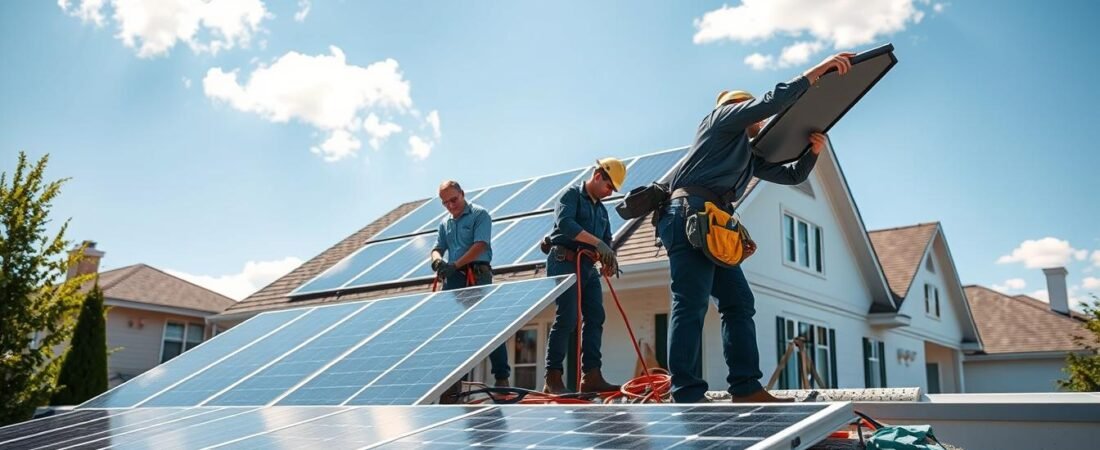
Ready to cut your electricity bills and boost your home’s energy independence? Our expert team provides professional solar panel installation northern virginia services that guide homeowners and businesses through a smooth, reliable process.
We design systems that fit your usage and budget. From the first consultation to years of performance, our solutions focus on long-term savings and strong system reliability.
Customers praise our clear guidance on costs, solar tax incentives, and renewable energy credits. We tailor every design to your home so you can enjoy better power management and reduced monthly bills.
Choose a team with real experience and positive reviews. Going solar is easier when a dedicated crew handles permitting, setup, and follow-up. Explore how a trusted system can secure your energy future.
Why Choose Professional Solar Panel Installation Northern Virginia
Quality workmanship and full-service care make the difference between a project that lasts and one that creates headaches. Our team delivers design, permitting, HOA coordination, SREC registration, and lifetime maintenance so your system works smoothly from day one.
Our Commitment to Expert Craftsmanship
We use proven methods and industry-grade materials to optimize output and durability. Every array is designed to match your energy needs and roof characteristics.
Correct installation matters. Proper mounting, wiring, and compliance checks reduce risk and extend system life.
Joining the Ipsun Family Experience
When you become an Ipsun member, you gain a partner for the life of your system. We provide ongoing support, maintenance, and rapid service if issues arise.
- End-to-end services: from design through lifetime care.
- Customized solutions: tailored to your home or business energy profile.
- Long-term value: installations built to last, maximizing returns.
Want to learn how to assess equipment quality? Read how to evaluate the quality of a solar for practical tips and checklists.
The Benefits of Transitioning to Renewable Energy
Adopting clean, renewable power helps families and companies cut costs while supporting local industry and farms. Virginia’s natural resources make it easy to harness dependable, low-cost energy.
Key benefits include:
- Lower monthly bills and reduced operating costs for your home or business.
- Less reliance on traditional fuels, so your system supports a cleaner future.
- Reliable power for agriculture and industry, boosting local productivity.
By going solar, you can cut taxes, increase profit margins, and move toward energy independence. Our support covers system design, permits, and long-term care so the transition stays simple and cost-effective.
“Switching to renewables is an investment that pays back in savings, resilience, and community benefit.”
Understanding the Virginia Clean Economy Act
Virginia’s updated clean economy law reshapes how homeowners and communities connect local systems to the grid. The Virginia Clean Economy Act (VCEA) raises the net metering participation cap from 1% to 6%, so more residents can offset electricity with on-site generation.
Impact on Grid Capacity and Renewable Goals
The VCEA sets a goal of 100% renewable energy by 2050 and phases out coal-fired plants. This creates demand for expanded generation and upgrades to grid capacity.
Key changes under the law:
- The net metering cap increase allows more homeowners to earn credits for excess output.
- Residential project size limits grow, enabling larger home systems and more meaningful savings.
- Specific allocations support low-income customers, promoting fair access to clean electricity.
Why it matters: Utilities and major providers are working with regulators to add protections for ratepayers. The law helps prepare the grid for a future powered increasingly by solar energy and distributed power, while advancing environmental justice.
“The VCEA is a major step toward a cleaner grid and broader customer access to renewable energy.”
Our Comprehensive Solar Installation Process
Our process focuses on clear steps that guide every homeowner from design to a working rooftop power system. We deliver end-to-end services so you don’t juggle permits, paperwork, or technical details.
Custom System Design
We start with a site visit and load analysis. This lets our designers size a system that matches your usage and roof layout. The result is a tailored plan that maximizes energy production and long-term value.
Navigating Permitting Requirements
Permits and inspections can slow projects. Our permits team prepares drawings, submits applications, and tracks approvals so timelines stay tight. We also handle SREC registration and interconnection paperwork for you.
HOA Coordination and Support
Not all neighborhoods are the same. We work with HOAs to present compliant plans and secure approvals. Our expert team manages communication so your project moves forward without homeowner headaches.
- End-to-end care: design, permitting, activation, and lifetime support.
- Peak performance: panels and system setup tuned for best energy yield.
- Trusted team: single point of contact from start to finish.
Maximizing Your Savings with Net Metering
When your system makes more electricity than you use, net metering lets you bank that value with your utility.
Net metering allows homeowners to sell excess electricity back to the grid and earn credits on their bill. Those credits reduce monthly costs and increase long-term savings.
We design systems to boost production so you get the most from net metering policies in your area. Proper placement of panels and a tuned solar system help capture extra energy on sunny days.
- Offset costs: Credits from excess power lower your utility charges.
- Smarter value: Our team explains how metering credits work so homeowners see clear returns.
- System design: We size arrays to match usage and maximize banked credits.
“Net metering turns spare output into monthly savings and greater energy independence.”
Want real savings? A well-designed solar panel setup makes net metering a powerful financial tool for your home and reduces reliance on the traditional grid.
Financial Incentives and Tax Credits for Homeowners
A range of tax credits and market programs make adding a home energy system far more affordable today.
The federal tax credit covers 30% of qualified costs. That cut can lower your upfront cost and shorten the payback window for a household setup.
Homeowners may also earn income from selling renewable certificates and from net metering credits when a system exports extra energy to the grid.
- Take the 30% federal credit to reduce initial cost.
- Sell Solar Renewable Energy Certificates (SRECs) or bank net metering credits to boost returns.
- Businesses and farms can use accelerated depreciation or USDA REAP grants to improve cash flow.
Average payback for a residential array is about 16 years. That creates decades of lower bills and steady savings after the break-even point.
“Use every available incentive — it makes the investment simpler and more rewarding.”
Long Term Maintenance and System Protection
Keep your investment productive with scheduled checks and fast repairs that prevent downtime. Our Paradise Protects plan delivers ongoing care so your solar panels and supporting equipment run reliably.
Regular service cuts the chance of surprise costs. We monitor battery health and battery storage to keep your home power steady. That proactive approach reduces wear and maintains performance.
What Paradise Protects includes:
- Routine inspections and cleaning to keep panels and inverters efficient.
- Continuous monitoring of batteries and smart alerts for faults.
- Priority repairs and discounted parts to limit downtime and costs.
“Protecting your investment with steady maintenance keeps systems at peak performance all year.”
| Service | Frequency | Benefit |
|---|---|---|
| Inspection & Cleaning | Annual | Higher output, fewer faults |
| Battery Health Check | Biannual | Longer battery life, reliable storage |
| Priority Repair | As needed | Faster fixes, lower unexpected costs |
Serving Communities Across the Commonwealth
From our office at 1931 S. High Street, Harrisonburg, VA 22801, our team provides expert solar installation and maintenance services across the commonwealth.
We support homeowners, farms, and businesses in cities such as Richmond, Roanoke, Charlottesville, Lynchburg, and Winchester. Our crew helps each customer navigate solar tax incentives, net metering, and renewable energy credits so the path to savings is clear.
Whether you want a residential system or a commercial array, we design solutions that match local needs. Our process covers permits, interconnection, and long-term care so your system works well for years.
- Blacksburg, Charlottesville, Culpeper, Fredericksburg, Harrisonburg
- Leesburg, Lexington, Lynchburg, Manassas, Richmond
- Roanoke, Stafford, Staunton, Warrenton, Winchester
“Our goal is simple: deliver reliable power options and lasting value to every customer.”
| Service Area | Audience | Primary Benefit |
|---|---|---|
| Statewide (from Harrisonburg) | Homeowners & businesses | Custom systems, local support |
| Rural & farm communities | Farmers & ag businesses | Durable arrays, federal credits help |
| Urban & suburban towns | Commercial customers | Lower electricity costs, fast ROI |
Comparing Residential and Commercial Solar Costs
Price per watt tells a clear story about residential versus commercial project economics.
Typical costs: Residential projects in VA usually run about $2–$3 per watt. Commercial work spreads lower, roughly $1–$2.50 per watt. These ranges help set expectations for total upfront cost.
We factor federal tax credits, net metering value, and long-term energy savings to show true return. That comparison changes the payback timeline.
Our team also advises on adding battery storage and batteries so your home or business keeps reliable power during outages. Integrating storage shifts value from just reduced bills to resilience and lower peak charges.
- Home: higher per-watt cost, easier permitting, direct bill savings.
- Business: lower cost per watt, larger arrays, faster ROI in many cases.
- Both: benefit from the 30% federal credit and net metering credits.
| Project Type | Cost per Watt | Key Benefit |
|---|---|---|
| Residential | $2.00 – $3.00 | Personal electricity savings, tax incentives |
| Commercial | $1.00 – $2.50 | Lower unit cost, stronger ROI for businesses |
| With Batteries | Varies (+ storage cost) | Backup power, peak-shaving, added resilience |
“Understanding costs helps you pick the right system for your home or business and get the best long-term value.”
Conclusion
Secure your home’s energy future with practical renewable energy solutions that balance savings and reliability. Our clear process focuses on system design, permitting, and output so you see value from day one.
By going solar with a residential solar system, homeowners gain tax credits and better metering that cut monthly bills and lower overall usage. The right approach turns incentives into measurable savings.
Our customers value the experience we bring after years of work in the field. Read reviews, ask questions, and see why many people show interest in this clean path to a smarter home.
Contact our team to learn how our solutions can help you save money and protect the future.