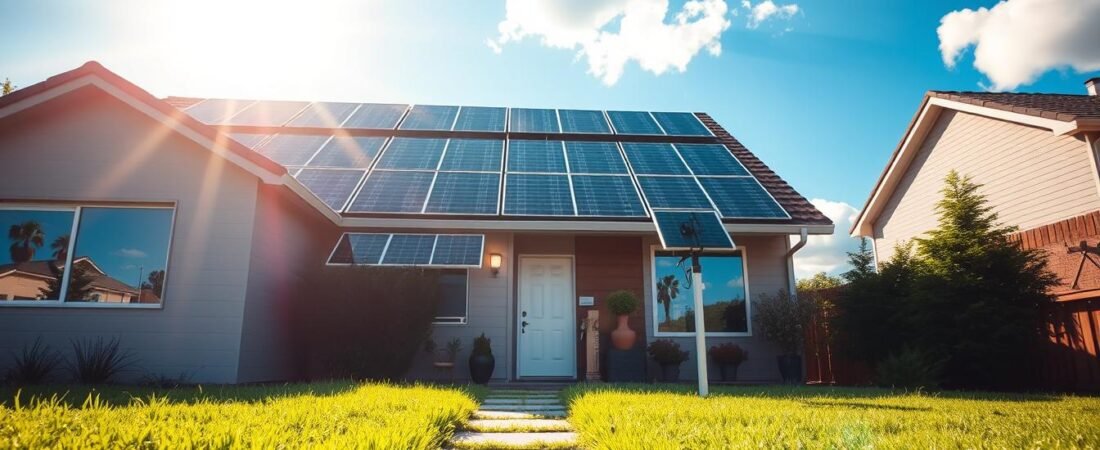
Ready to gain energy independence? Many homeowners ask how many units they need and what kit will give steady power. A complete bundle can simplify the switch and cut guesswork.
Portable solutions are popular for travel, camping, and work in a truck. Modern setups pair panels with a good battery and an easy-to-install kit. This makes it simple to run lights, fridges, and small devices on the go.
Choosing the right system begins with listing your energy needs and matching capacity to that list. A high-quality bundle keeps appliances running reliably, whether at home or on the road. In this guide, we walk through options that fit typical U.S. households and outdoor lifestyles.
Understanding Your Home Energy Consumption
Start by measuring how much electricity your household uses each month. The EIA reports the average U.S. residence used 10,791 kWh in 2022. That number helps set realistic goals when you size a renewable setup.
Calculating Wattage
To find a device’s draw, multiply its wattage by hours used each day. If you know circuit voltage, multiply amps × volts to get watts. This gives the daily power output per device.
Identifying High-Usage Appliances
Focus first on large loads. Refrigerators often need 150–800 watts to run. HVAC systems and electric water heaters are other top contributors.
- Track consumption: Use a smart plug or whole-house monitor to spot big users.
- Prioritize loads: List essential devices to run during outages.
- Estimate totals: Add device watt-hours to see daily and monthly energy needs.
| Device | Typical Watts | Hours/day | Daily Wh |
|---|---|---|---|
| Refrigerator | 150–800 | 24 | 3,600–19,200 |
| HVAC (avg) | 1,000–4,000 | 4–8 | 4,000–32,000 |
| Lighting & devices | 50–600 | 3–8 | 150–4,800 |
Understanding total usage is the first step to matching output to needs and choosing the right system size.
Calculating the Right Solar Panel for Home Appliances
Begin with your annual kWh use and divide by the estimated yearly output of a 400-watt module. Then apply a production ratio between 1.3 and 1.6 to account for regional losses and weather.
Example: If your yearly need is 10,000 kWh, a 400 W unit’s annual yield (adjusted by 1.4) gives a quick panel count. Increase that number if peak sun hours are low.
- HVAC load: Typical systems draw 3,000–3,500 W. That strongly affects sizing.
- Mini split benefits: Modern mini split heat pumps using R32 run efficiently and can cover heating and cooling with less draw than older AC units.
- Professional check: An installer will refine estimates and confirm the array can run an essential pump without grid backup.
“Use a 1.3–1.6 production ratio and 400 W average rating to estimate how many units you need.”
| Item | Typical Load (W) | Panel Basis | Sizing Note |
|---|---|---|---|
| Mini split pump | 800–2,000 | 400 W unit | R32 improves efficiency; fewer modules may suffice |
| Central HVAC | 3,000–3,500 | 400 W unit | Plan larger array or hybrid backup |
| Low-sun regions | Variable | 400 W unit | Increase count; use higher production ratio |
Need a tailored estimate? See how many panels are needed for a practical calculator and installer guidance.
Essential Components for a Reliable Solar System
Map your essential loads, then choose system elements sized to keep those items powered.
Hybrid Inverters and Battery Storage
The EG4 12000XP hybrid inverter acts as the brain of the setup. It manages output from modules and battery banks to keep circuits stable.
High-voltage battery storage compatible with EG4 hybrid units provides strong backup during outages. Every EG4 component ships with a comprehensive warranty.
Transfer Switches for Grid Backup
A transfer switch lets you link the backup system to the grid safely. It isolates circuits so critical loads stay powered without backfeed risks.
Solar Kits and Bundles
Many kits now include an Anker Solix power station for portable use. Use a 12V battery in a compact kit to run small devices when away from the house.
Tip: Pick a kit or bundle that allows adding a generator for low-production stretches.
| Component | Role | Quick Benefit |
|---|---|---|
| EG4 12000XP | Hybrid inverter | Efficient conversion, system control |
| High-voltage battery | Storage | Extended backup, scalable |
| Transfer switch | Grid safety | Safe backup switching |
| Anker Solix | Power station | Portable energy, 12V support |
Strategies to Maximize Energy Efficiency
Routine care keeps your array and battery running near peak output through changing seasons. A few simple tasks each spring and after storms prevents performance drops. These actions protect your investment and keep daily power steady.
Maintenance tip: clean pollen, dust, and debris in spring to restore full output. In winter, schedule inspections to spot ice or damage that cut production.
Keep filters in a mini split and air conditioner clean. That lowers the draw on your battery and system. A well-serviced heat pump or pump saves energy and extends equipment life.
If you see lower power or output, check for shading or obstructions on the panel array. Clearing branches or grime often restores performance quickly.
“Regular maintenance keeps batteries charged and systems reliable even when weather limits production.”
| Task | When | Benefit |
|---|---|---|
| Clean modules | Spring, after storms | Improves output, prevents soiling losses |
| Inspect hardware | Winter and post-storm | Catches damage early, keeps power reliable |
| Service filters | Every 1–3 months | Reduces load on air conditioner and pump |
Monitor usage and adjust habits to match production. Use resources like summer energy tips to trim demand during peak heat and protect your battery reserve.
Conclusion
Key takeaways, a well-sized system gives reliable backup and helps protect your budget against rising rates.
Plan with numbers: measure daily demand, work with a professional, and choose hybrid technology and a quality battery to secure critical circuits.
Routine care keeps production steady through seasons. Clean arrays, inspect mounts, and service HVAC filters to cut unnecessary draw.
Investing now and understanding your needs makes it easier to pick the right solar panels and setup to power essential appliances and keep your home running smoothly.