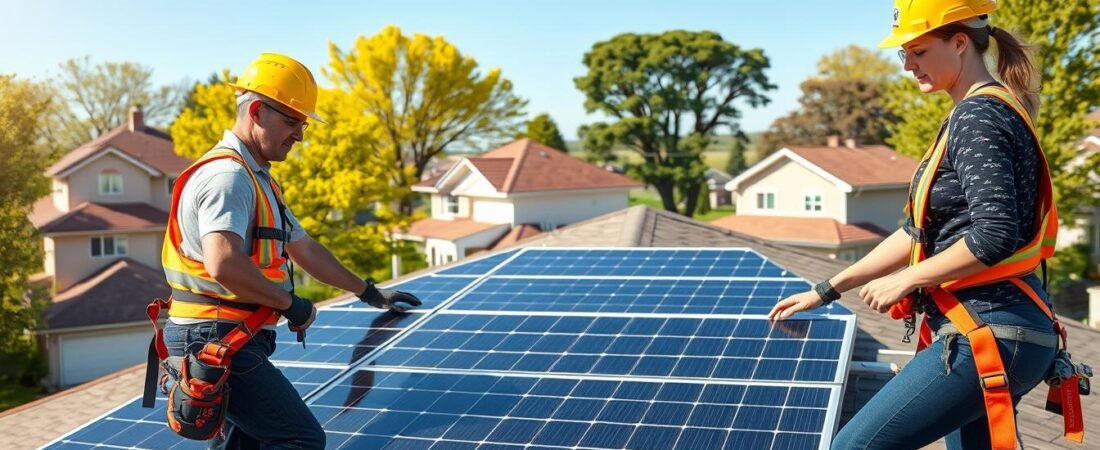
Finding the right team for your home matters. We cut through the noise to highlight trusted pros who deliver durable systems and clear customer service. Our guide focuses on installers with strong reviews, solid warranties, and years of real-world experience.
Each recommended company was vetted for quality and roof protection. You get practical advice about installation choices and long-term savings. We spotlight firms that know how to handle local weather and code requirements across MI.
Going solar is a big step. This intro helps you weigh service, system design, and warranty terms so you can choose the best option for your home. Read on to learn which installers combine experience with customer-first care.
Why Michigan is a Prime Location for Solar Energy
You might be surprised how well Michigan’s climate supports rooftop energy systems.
Climate considerations matter less than many expect. The state averages about 4 peak sun hours per day and roughly 170 sunny days yearly. Modern panels still generate power on cloudy days, so performance is steady through seasons.
Cold weather can actually improve efficiency, while installers design mounts and equipment to handle heavy snowfall. That attention to durability and proper warranty often translates to long-term peace of mind for the homeowner.
Energy independence is another big benefit. Generating your own clean energy lowers electric bills and cushions you from rising utility rates. Over time, a well-sized system can offer real savings and boost property value.
- Reduce monthly electric bills and lock in long-term savings.
- Choose durable equipment built for cold and snow.
- Gain energy independence and lower grid reliance.
| Factor | Michigan Average | Benefit to Homeowners |
|---|---|---|
| Sunny days | ~170 days/year | Reliable seasonal generation |
| Peak sun hours | ~4 hours/day | Steady daily output for most roofs |
| Winter performance | Improves in cold temps | Higher efficiency; durable installations |
| Financial impact | Lower electric bills | Long-term savings and higher resale value |
Understanding the Solar Panel Companies in Michigan Landscape
With over 85 installers active across the state, choosing a trustworthy partner means reviewing more than price. Look for firms that share clear timelines, visible warranties, and straightforward installation steps.
Local presence matters. A company with regional experience knows how to size a system that fits your roof and the local code. That insight helps protect your investment and improve long-term savings.
Check reviews and ask for a site assessment. A qualified installer will inspect roof angles, shading, and mounting needs before quoting. Ask how many years the team has worked locally and what post-installation service looks like.
| What to Check | Why It Matters | Quick Tip |
|---|---|---|
| Local reviews | Shows reliability and customer service | Read recent feedback from customers |
| Roof assessment | Ensures optimal panel placement and safety | Request a written site report |
| Warranty & years | Points to long-term support and experience | Prefer 10+ years of service history |
Essential Criteria for Evaluating Solar Installers
Start by checking credentials and licenses to ensure safe, code-compliant electrical work. Ask for proof of licensure and current insurance before any estimate is written.
A reliable installer will offer a clear workmanship warranty that protects your roof and system long term. Warranty length and what it covers matter for future repairs and resale value.
Compare multiple quotes to find fair pricing and realistic savings projections. Look beyond the sticker price; check included equipment, labor, and permitting fees.
A professional company always performs a detailed site assessment. That visit should review roof condition, shading, and energy needs to size the panels and system correctly.
- Verify licenses and insurance
- Confirm workmanship and equipment warranty
- Get 3+ quotes and compare scope
- Require a written site assessment
- Prioritize installers with positive reviews and service history
| Check | Why it matters | Quick action |
|---|---|---|
| Licenses & insurance | Protects you from liability and ensures code compliance | Request certificates before signing |
| Workmanship warranty | Covers roof repairs and installation defects | Prefer multi-year written guarantees |
| Site assessment | Ensures proper sizing and placement for best performance | Ask for a written report |
| Customer reviews | Shows real experience and service quality | Read recent feedback and ask for references |
The Importance of Years of Experience in the Industry
Choosing a team with many years on the job reduces the risk of costly surprises down the road.
Years experience matters because it reflects real-world problem solving, steady service, and verified reviews from customers. We suggest looking for companies that have at least five years experience. That baseline helps ensure crews know local code, roof challenges, and proper installation sequencing.
Long Term Warranty Support
Long warranties show confidence. Reputable installers often back a full system for 25 years. That kind of support covers equipment, workmanship, and roof protection over a typical system lifespan.
- Five+ years experience usually signals reliable after-sales service and solid warranty options.
- Choosing a seasoned solar company means you gain a partner to maintain panels and monitor system health for decades.
- A lengthy warranty is a hallmark of quality and reduces long-term maintenance costs, improving savings.
Verifying Licenses and Insurance for Your Protection
Make it a rule to demand proof of licensure and insurance from any service provider bidding on your roof. This protects your home and your wallet if an accident or code issue arises during installation.
Professional installers must hold the right electrical credentials to install a system safely and up to code. Ask for copies of licenses and confirm they are current with the state licensing board.
Always request proof of liability and worker coverage so you won’t be liable if a worker is injured on your roof. A reputable company is transparent about these documents and about certifications like NABCEP.
“Proper licensing and insurance are non‑negotiable. They show a company takes safety and long‑term warranty commitments seriously.”
- Confirm electrical license numbers and check online.
- Request liability and workers’ compensation certificates.
- Look for NABCEP or comparable certifications as a quality signal.
| What to Verify | Why it Matters | Action |
|---|---|---|
| Electrical license | Ensures code‑compliant installation | Check license number with state board |
| Liability insurance | Covers property damage during work | Request current certificate |
| Workers’ comp | Protects you from injury claims | Confirm policy covers crew on your roof |
| Certifications | Shows industry training and standards | Ask about NABCEP or equivalent credentials |
Navigating Financing Options and Solar Loans
Financing choices can change how quickly your investment starts paying for itself. Exploring loans or a power purchase agreement lets you manage upfront costs and plan monthly cash flow.
Cash Purchases
Paying cash usually yields the best long-term savings and the fastest return on investment. You avoid interest and often qualify for full tax credits and incentives.
Cash buyers also simplify warranty transfer and future resale value. Ask your company for a written breakdown showing lifetime savings versus loan options.
Power Purchase Agreements
PPA arrangements let you buy energy, not ownership. That lowers your upfront burden while still cutting electric bills from day one.
Carefully review any escalator clauses and the service terms. A reputable company will compare PPA, loan, and cash paths and disclose fees, interest rates, and expected savings.
- Request clear comparisons and written fee schedules.
- Check how warranties and years of coverage apply under each option.
- Read installer reviews and ask for customer references before signing.
Assessing Services and Equipment Quality
Start by checking the equipment list and service options a provider includes with each quote. That gives you a clear view of what you pay for and how the system will perform over time.
High‑quality panels typically have efficiency above 19% and come with 25‑year product and performance warranties. Make sure the quote lists warranty terms and what they cover.
Ask whether the company installs battery storage or electric vehicle charging. These add‑ons affect system sizing and future savings. A thorough installer will explain compatibility and costs.
- Brands used: Request model names for modules and inverters.
- Weather readiness: Confirm equipment is rated for local snow, wind, and temperature swings.
- Customer service: Ask how they handle service calls and monitoring after installation.
“Quality gear plus responsive service prevents most long‑term headaches and protects your investment.”
Interpreting Customer Review Scores and Feedback
Review scores are a shortcut to gauge reliability, but they need context. Check ratings on Google and Yelp, then read recent comments for patterns.
Look for repeated praise about customer service and speed of installation. Positive reviews that mention warranty handling and follow‑up support matter most.
Be cautious with short, glowing blurbs. They can mask issues like missed timelines or poor roof care.
- Prioritize companies with many detailed reviews over a few perfect ratings.
- Note how a company responds to criticism — prompt replies show accountability.
- Long history of positive reviews and steady ratings often signals years of consistent service.
“Reviews that detail service, warranty claims, and system performance give the clearest picture of long‑term value.”
| Platform | What to Check | What It Signals |
|---|---|---|
| Recent, detailed reviews | Reliability and service follow‑through | |
| Yelp | Problem resolution stories | Customer service quality |
| Industry forums | Technical feedback on panels and system | Equipment performance and installer skill |
Maximizing Savings with Michigan Solar Incentives
Upfront costs shrink quickly when you combine federal credits with state billing rules. Understanding available incentives helps you map real savings and set clear payback expectations.
Federal Tax Credit Benefits
The 30% federal tax credit cuts the total price of a residential system significantly. Any taxpayer who files can claim it and lower their tax liability.
At the state level, Michigan offers a 1-to-1 net metering policy that credits exported energy at retail value. That policy boosts long-term savings by reducing billed usage.
- 30% federal credit: Reduces the cost of your solar installation and improves ROI.
- Net metering: Earn full retail credit for excess generation and lower monthly bills.
- Professional guidance: A qualified company will help claim credits and verify eligibility to maximize savings.
“Installing panels is a strategic financial move that can lead to thousands of dollars in savings over the lifespan of your system.”
How to Compare Solar Quotes Effectively
Focus on apples‑to‑apples comparisons: check system size, warranty length, and the per watt cost each quote shows.
Use the state average price of $2.13 to $3.19 per watt as a quick benchmark. Ask every provider to show price per watt and projected yearly output so you can compare expected savings.
Get at least three written solar quotes from different installers michigan to spot hidden dealer fees or add‑ons. A top rated solar company will list total cost, equipment models, and permit charges clearly.
Customer service matters as much as cost. Choose a firm that answers questions about maintenance, monitoring, and warranty claims.
- Confirm per watt and total system cost.
- Ask for model names for panels and inverters.
- Request written warranty terms and expected years of coverage.
- Compare projected savings and read recent reviews before you decide.
“Detailed quotes reduce surprises and help you pick the best solar installer for your home.”
Analyzing System Size and Energy Production Estimates
Estimate accuracy starts with matching system size to your home’s real energy use. A qualified installer will review your electric bills and daily habits to set a realistic target.
Michigan averages about 170 sunny days and roughly 4 peak sun hours per day. Even with that climate, a properly sized system can deliver meaningful savings when calibrated to usage and roof exposure.
When you review production estimates, confirm the quote accounts for shading, roof orientation, and local weather. Ask the installer how they modeled losses from trees or vents.
Compare quotes by size and by expected output. If one proposal shows a much smaller system or a much lower per watt price, ask the company to explain the assumptions behind the numbers.
- Check consumption matching: system sized to your yearly kWh usage.
- Verify site factors: shading and roof angle reduce output.
- Demand clear metrics: ask for yearly kWh estimates and expected savings.
“An accurate production estimate gives you confidence in savings and warranty coverage over the system’s years of service.”
Understanding the Role of Solar Batteries in Michigan
A backup battery offers real peace of mind during long winter outages. Many homeowners value stored energy when storms knock out power. A battery can keep critical circuits running and protect food, heat, and communications.
Even with net metering available, storing excess daytime output can reduce what you pay on high‑use evenings. That means extra savings on your electric bills by shifting when you use stored energy.
Today, several local companies sell integrated battery options that pair with existing panels and inverters. A qualified installer will evaluate roof capacity, expected production, and warranty overlaps to see if adding storage makes financial sense for your home solar setup.
Choose a reputable company to ensure correct installation, safe wiring, and proper warranty coverage. Good installers include monitoring and service plans so your system and battery perform well for years.
“A battery could help preserve power during storms and cut evening electric bills when used smartly.”
- Battery storage helps during winter outages.
- It can improve savings by shifting energy use.
- Ask your installer for cost vs. years of benefit and warranty details.
Recent Legislative Changes and Solar Rights
A fresh state policy removes barriers that once blocked many households from adopting clean energy. The 2024 Homeowners’ Energy Policy Act stops HOAs from unfairly banning rooftop installations. This gives owners clear legal ground to add panels and a system for their homes.
The law helps protect your right to generate power and supports Michigan’s push toward 2 million ZEVs by 2030. Having a home system makes it easier to charge an electric vehicle and increase long‑term savings.
Choose a company or installer that knows current rules. A knowledgeable provider will ensure your installation follows state and local codes and that warranties remain valid for years.
“The 2024 act is a major win for homeowners who want reliable access to clean energy.”
- HOA bans are limited, protecting homeowner choice.
- Rights to install boost EV charging and household savings.
- Pick a provider with recent reviews and local experience to stay compliant.
Preparing Your Home for the Installation Process
Simple prep steps at home make the actual installation faster and safer. Before work begins, a site visit confirms your roof can support the array and that mounts will fit without surprises.
Site Assessment Visits
A qualified installer will schedule a walk‑through to check roof condition, shading, and electrical access. They measure roof space, document penetrations, and note any repairs needed before crews arrive.
Tip: Clear attic access and remove fragile items near the work area to speed the job.
Permitting and Documentation
Your chosen company handles permit filings, interconnection paperwork, and utility forms. This saves time and reduces paperwork errors.
Installation typically takes one to three days for racking, wiring, and panel placement. After crews finish, a town representative will inspect the system and approve grid interconnection.
“A reliable company will manage every step so the process is smooth and clear for the customer.”
| Step | Who Does It | Typical Timing |
|---|---|---|
| Site assessment | Solar installer | 1 visit before contract |
| Permits & paperwork | Selected company | Varies by town (days to weeks) |
| On-site installation | Installation crew | 1–3 days |
| Final inspection | Town representative | After installation completes |
For a clear overview of the full panel installation process, ask your installer for a timeline and permit checklist. That helps you track progress and plan for quick interconnection and savings.
Monitoring the Growth of Utility Scale Solar Projects
When a 250MW project secures $334 million in financing, it sends a clear signal: large clean energy builds are moving forward.
The Calhoun Solar project backed by NorthStar Clean Energy is a major milestone for the regional industry. Large projects like this help replace aging fossil plants and boost grid reliability.
As utility-scale work expands, the know-how gained by installers and companies filters down. That experience improves residential system design, installation quality, and warranty service for customers.
“Utility-scale projects are not just power sources — they are training grounds that raise standards for smaller installations.”
- 250MW Calhoun: $334M financing — proof of investor confidence.
- Grid benefit: more reliable, cleaner generation replacing old plants.
- Economic impact: jobs, supply chain growth, and stronger local expertise.
| Metric | Impact | Why it matters |
|---|---|---|
| Project size (250MW) | Large-scale generation | Displaces fossil generation and stabilizes the grid |
| Financing ($334M) | Investor confidence | Attracts more builds and supply investment |
| Installer experience | Improved workmanship | Better residential installation and long-term savings |
Conclusion
Choosing the right provider matters. Pick one of the best solar companies for lasting savings and reliable service.
Focus on customer service, years of experience, clear warranty terms, and strong reviews. Compare multiple quotes and verify that the chosen company holds proper licenses and insurance before signing.
Want help with next steps? Visit our services for a clear overview and licensed installer options that can simplify installation and protect your roof while boosting long‑term savings.