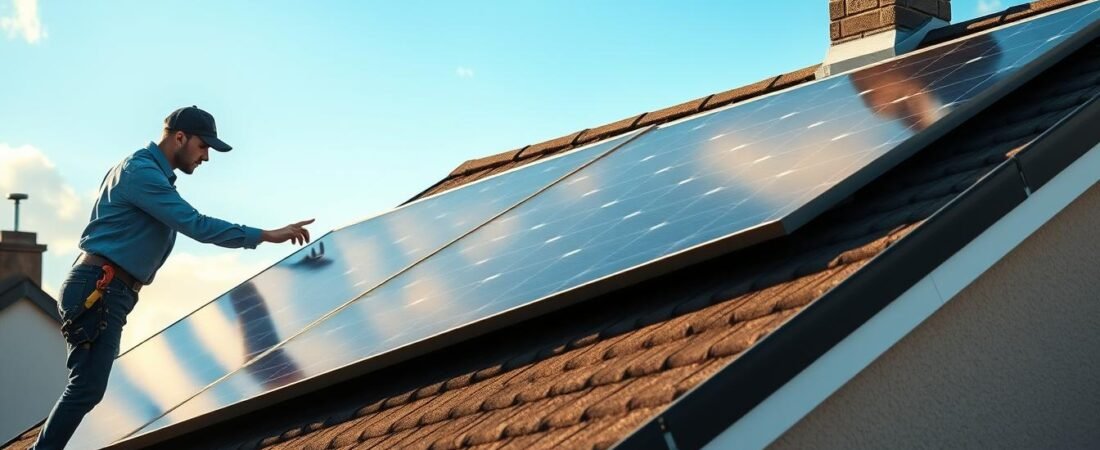
Your home deserves clean, dependable energy. Our expert team guides homeowners through every step, from the first site survey to the final commissioning. We make the process clear and the results long lasting.
We handle permits, safety checks, and standards to keep your property compliant with local rules. Choosing a professional system reduces reliance on the grid and cuts electricity bills.
Our installers fit high-quality panels and offer options for battery storage so excess power is stored for evening use. That helps households get more from their investment while lowering costs.
Want a straightforward quote and expert workmanship? Learn about turnkey options and warranties by visiting our solar PV service page.
Key takeaways: Expert, end-to-end service; better energy use with battery-ready systems.
Reliable Solar Panel Installation for Glasgow Homes
Every job we complete blends smart engineering with attention to how your home looks and performs. We fit each component to industry standards so the system runs efficiently and lasts for years.
Our team tailors panels to local roofs and weather. This bespoke approach helps capture more energy across changing seasons.
We use advanced monitoring and quality materials. That means steady electricity for daily use and clear data on system output.
- Durable components that protect your property and lower utility costs.
- Seamless integration with battery options for evening power.
- Careful site work to preserve your roof and curb appeal.
| Service | Benefit | Typical Result |
|---|---|---|
| Professional fit | Long-lasting performance | Consistent power and fewer repairs |
| Custom design | Maximized energy harvest | Higher daily electricity yield |
| Battery-ready systems | Evening power availability | Reduced grid dependence |
Choose a trusted crew and you invest in a robust system that serves your home and property for years.
How Solar Energy Systems Work
Daylight hitting PV cells begins the process that turns light into usable electricity for your home. This conversion of light into DC current is the core of how solar energy works. An inverter then converts that DC into AC for everyday appliances.
The Science of Photovoltaics
Photovoltaic cells free electrons when struck by light, creating a flow of current. This is why solar panels work even on cloudy days—light still reaches the cells.
Understanding this science helps homeowners see why systems deliver steady energy and measurable savings.
Essential System Components
- Modules and inverter: cells generate DC, the inverter makes usable AC.
- Generation meter: tracks how much electricity your property produces each day.
- Mounting and roof hardware: secure the modules for long-term durability.
- Battery storage: a solar battery saves surplus energy for evening power.
Our solar panel installers and panel installers provide clear training so you can monitor output, optimize energy use, and protect your investment after installation.
Key Benefits of Switching to Solar Power
Investing in on-site electricity generation shields your home from rising utility prices.
Switching to solar power is one of the most effective ways to reduce your monthly energy bills while protecting your household from future price rises. Generating your own electricity lowers reliance on the national grid and gives your property greater energy independence.
Many homeowners see higher property value after adding solar panels. Well-designed systems also deliver long-term savings and often pay back their costs through reduced utility bills over time.
“Exporting surplus electricity to the national grid can create an extra income stream.”
- Cut monthly energy bills and gain protection against rising costs.
- Decrease reliance on the national grid and improve home resilience.
- Increase property value and earn from exported surplus via SEG.
- Optimize performance with a battery-ready system tailored to your property.
Our Professional Solar Panel Installation Glasgow Process
Start with a free consultation and a clear roadmap to a tailored energy system for your property. Our team explains timelines, expected costs, and likely savings so you can decide with confidence.
Initial Consultation and Site Survey
We begin with a no-obligation visit. A detailed site survey checks roof orientation, shading, and wiring access today. Since 2008 most local installs are permitted development, and we handle paperwork to keep things compliant.
Professional Installation Standards
Our MCS-certified installers carry out every panel installation to industry standards. We mount modules securely, test output, and minimize disruption to your home and daily routine.
Handover and Training
At handover we provide a clear, itemized quote and full system documentation. You get hands-on training to monitor generation, manage a solar battery, and optimize energy use for better performance.
- Free site survey and tailored quote.
- Certified installers and secure roof mounting.
- Training and support for long-term savings.
Understanding Costs and Financial Incentives
Budgeting for a new energy system starts with understanding up-front costs and long-term savings.
A typical 4 kW domestic system in Scotland costs between £6,000 and £7,500 and can save roughly £600–£900 a year on electricity bills. That often means payback in about 8–10 years, with reliable savings for 25+ years.
Good news for homeowners: most domestic installs are eligible for 0% VAT until March 2027. That reduces the initial cost and makes a quote more attractive today.
- We provide a transparent quote that lists cost, expected savings, and timelines.
- Advice on grants, loans, and low-rate financing to help with battery storage and system upgrades.
- Practical tips to align a solar battery with your usage to cut energy bills further.
| Item | Typical Range | Annual Savings |
|---|---|---|
| 4 kW system cost | £6,000–£7,500 | £600–£900 |
| VAT | 0% until Mar 2027 | Lower upfront cost |
| Payback | 8–10 years | 25+ years savings |
Request a clear quote to see exact costs and projected savings for your property. That lets you compare options and plan investment with confidence.
Choosing the Right System for Your Property
Smart system selection begins by mapping sun exposure and matching output to your home’s typical demand. We check roof angle, orientation, and shading so your panels deliver steady electricity and strong savings.
Optimizing Roof Orientation and Pitch
We assess roof pitch and direction to place modules where they gather the most light. A south-facing roof often works best, but east and west faces can perform well with a thoughtful layout.
Our team factors in nearby trees and buildings to avoid shading that reduces performance. We also size the system to match daily usage and future plans like a battery or EV charger.
- Custom sizing: match output to your energy patterns for maximum savings.
- Quality equipment: MCS-certified components for long-term reliability.
- Future-ready: design that allows adding a battery or charging point later.
“A well-designed installation boosts daily output and enhances property value.”
Integrating Battery Storage and Electric Vehicle Charging
Pairing storage with vehicle charging turns daytime generation into 24/7 usable power. Adding a solar battery storage system lets you capture surplus output and use it in the evening. That reduces reliance on the grid and cuts electricity costs.
We install advanced battery systems that work with your panels and keep critical circuits live during outages. Our installers size the battery to match your usage so you get the best self-consumption and long-term savings.
- Seamless EV charging: charge an electric vehicle directly from rooftop generation for lower running costs.
- Future-proof systems: combine panels, storage, and a charger to build a complete energy solution for your property.
- Expert guidance: we recommend battery tech, battery capacity, and setup that suit your home and budget.
“A well-sized battery gives you control over electricity use and predictable savings.”
Real World Results and Performance
Actual results from completed projects reveal both savings and real-life performance trends.
In Bearsden a 4 kW system with a 5 kWh battery cut grid electricity use by 72% in six months. That shows how effective solar battery storage can be for a small home.
At a commercial site in Stirling a 50 kW array produced over 40,000 kWh a year, saving more than £8,000 on electricity bills. Ground-mounted panels in Falkirk also proved reliable across seasons.
Monitoring makes these outcomes clear. Our solar panel installers provide training so homeowners and businesses can track output and savings today.
- Real projects show that solar panels work well in Scotland’s climate.
- Performance data guides every new installation for better efficiency and lower cost.
- Customers report reduced energy bills and higher property value after upgrades.
“Proven results give confidence and real value for home and business owners.”
Start Your Journey Toward Energy Independence
Take the next step toward lower bills with a free, no-obligation quote from our expert team. We deliver clear pricing and a simple plan so homeowners can decide with confidence.
Our tailored energy solutions help you install solar panels and add battery storage. We size each system to match your home’s needs, so you get reliable power and long-term savings.
Work with certified solar panel installers who handle permits, setup, and handover training. Join satisfied homeowners who have cut bills and boosted property value.
Contact us today for a quick assessment and a transparent quote. We make switching to clean power easy and stress-free.